Blog 3: Research Gap
As I wrote my literature review, I found my research steering me back to a more-defined PTW focus. I initially focused on how the field of health communications might need a technical communicator to help make sure intersectional health interventions had their intended rhetorical effect, i.e. that when program designers address health disparities among racial, class, and gender lines, they do so in a way that invites a wider array of stakeholders and focuses on long-term transformation. As I went through the research, however, my approach to health interventions changed. I still retained the intersectional focus, but I started considering the institutional faults that went into health interventions, such as taking scientific claims as ontological certainties, treating participants as passive subjects, and reducing the agency patients should have in improving their own health literacy. These are all faults that a technical communicator--someone who mediates information between the subject matter expert and the lay audience--can mitigate through careful program design and assessment.
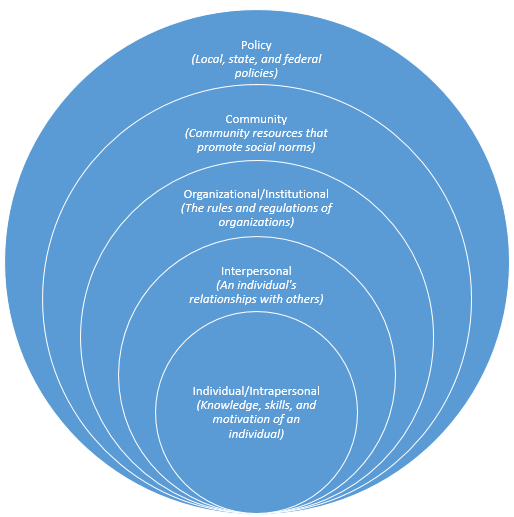
Therefore, my gap highlights this disparity between using either a top-down or bottom-up approach--one that directly empowers the targeted community or destabilizes the institutional power that effects said community (see the ecological model below). Maybe there are opportunities to take both approaches concurrently, but what lacks are practical ways to work on those fronts. I'm thinking my research would fall into the qualitative or mixed-method realm, but I am uncertain about what form that would take (e.g. document analysis of local hospital and clinic pamphlets, observation of intensive health program, focus group of minorities and their relation to health).
 |
| Wikimedia Commons |
It's interesting to read how your initial subject for your literature review evolved and incorporated institutional faults into the main idea. I ended up expanding my initial topic as well; finding more sources with ideas that weren't considered at first give a better idea of the whole picture of an issue, so it's cool to see how that fit into your review. Your topic is also fascinating and of great importance (especially now!), and I look forward to seeing how you end up designing your research proposal.
ReplyDelete